Sunday, March 10, 2013

Art, Gender, and Conflict March 4th

I attended the Art, Gender, and Conflict lecture on March 4th where Patricia Arisa (sp?) spoke about the founding and continued work of her ground breaking theater in Colombia, the Casa del Cultura. Patricia is the author of over two dozen books, is an actress, and most importantly, is a political activist in a country that has four million displaced people, most them women, and that is plagued with immense social inequality. Colombia also suffers from perpetual violence; it has been in armed conflict for over 50 years. Patricia pointed out that the paramilitary uses the body's of women as loot. In response to the problems of the country Patricia and her fellow directors (many of them women) write and perform plays that display options and solutions for women. Patricia stated that through this type of work women use their body's to represent themselves in a poetic way in public spaces. For example, the theater puts on a monthly show in central plazas that have historically represented masculinity and patriarchy. In one of the short films, "Mujeres en la Plaza," the Swatchas (sp?), women who have had their children abducted, were joined by other groups of women demanding  that the government tell them the whereabouts of the missing people.

I think one of the most significant ways in which this lecture relates to our class is that these women are discovering the truth about their situations through each other. Patricia shared that through sharing stories with one another women are arriving at truths through conflicting stories told by the government and their own experiences. I have personally been learning a lot about my own situation from reading the stories of other women. Additionally, Patricia shared that this is not just a "feminist" event in Colombia, but rather that this is an event for peace and social justice globally, which, from what I have gathered, is big theme in our class.

Note: I apologize if the spellings of important details are incorrect. The lecture was completely in Spanish and I spelled things phonetically, hence the (sp?).

Domestic Workers Reflection--GRWC 3/7

I attended the GWRC session about domestic workers in the United States (specifically California.) The panel consisted of four women: three who work for non-profit organizations pertaining to issues of domestic workers' rights and one who is a scholar of Catholic social thought. The speakers presented about the issues that domestic workers, almost entirely women of color, face in an industry that is extremely unregulated and private. Many of these workers are overworked, underpaid, and frequently abused. They are often lured into the country under false pretenses and afraid to report any injustices because of the threat of deportation. One of the immigrant groups most impacted is Filipino workers, many of whom find jobs providing care for the elderly. Activist groups had tried twice to introduce a Domestic Workers' Bill of Rights into the California legislature, but have been denied.

The presentations did not focus on gender or often mention the sex of the workers, but the subject matter and domestic work itself is extremely gendered. The presentations reminded me of the conversations we have had in class about how undervalued "women's work" is, i.e. cooking, cleaning, and anything associated with being a housewife. The women that we heard about in these presentations work incredibly hard, working long hours in physically demanding jobs, but are underpaid and under-appreciated. The main idea behind the panel is the same as the concept we've discussed in class--in order to begin to fix this oppression and dismissal of domestic work, we must redefine it as real work.

Wednesday, March 6, 2013

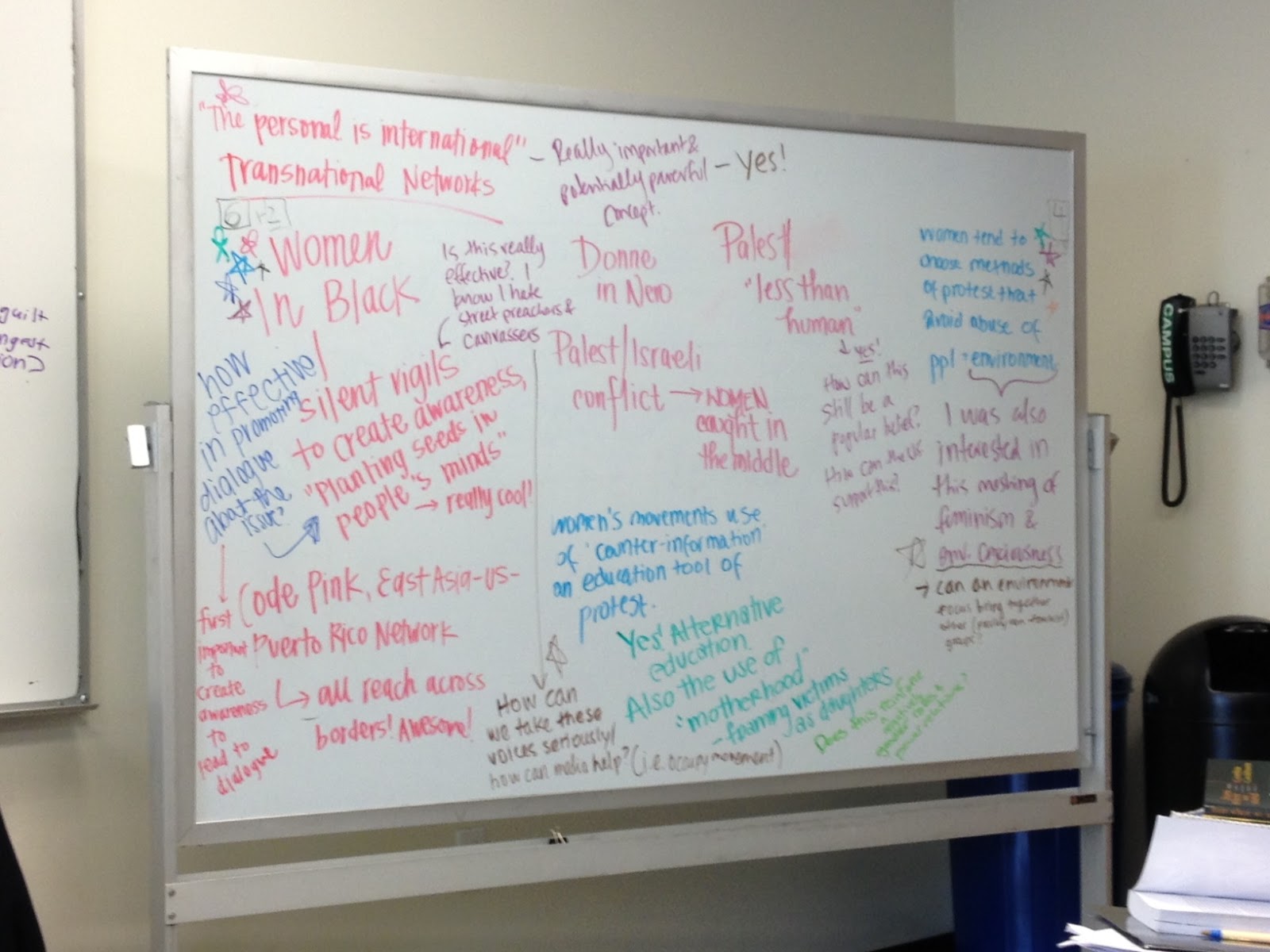
Silent Discussion : 03/04/2013

Click on the image to see the original photo size, which allows you to zoom to see the text.


Feminist Security Studies and Today’s Challenges

I was recently interviewed by The Globalized World Post - I thought you might find this interesting as well:

Feminist Security Studies and Today’s Challenges: A Q&A Session with Annick T.R. Wibben

Annick T.R. Wibben is an Associate Professor of Politics and International Studies at the University of San Francisco, California and an expert in Feminist Security Studies. She has written extensively on feminism and security and has published a very influential book on the field of Feminist Security Studies, ‘Feminist Security Studies: A Narrative Approach’. On the first Q&A Session of The Globalised World Post she talked with Marianna Karakoulaki, editor of the magazine, about Feminist Security Studies in general as well as specific issues that have been under discussion recently. The discussion began on a more theoretical level but then moved to more specific issues, from the importance of specific UN resolutions to rape as a weapon of war, from the gang rapes in India to third wave feminism, and finally to women in combat in the USA.

Comments very welcome!

Monday, March 4, 2013

Revision of Ann Jones' Chapter on Burmese Refugees

Ann Jones' chapter on the Burmese refugees in Thailand  focuses on the processes and struggles of her project the "Global Crescendo Project" which used photography as a means of documenting the daily lives of displaced Burmese minorities in Thailand. Mainly focusing on the Karenni women, who were thought to be shy and self-contained, the GCP brought a voice to many of them, as well as bridged the "gap between women and action" that exists as a result of impunity and patriarchy. Beyond the common difficulties in the camps, such as disease that passes quickly throughout camp refugees, domestic violence is in high frequency but seldom acknowledged, as "women endure violence because they saw no other choice,". As Jones' points out, such violence is incredibly ironic because it was a similar form of GBV, or torture, that the refugees were escaping from in the first place. Most importantly, the GCP began a path to educating and teaching men "how the problem starts and how they can solve it by themselves", learning, and using their knowledge of their history of suffering to promote rights and security writhing the community and the private sphere.

Ann, Jones. "Burmese Refugees in Thailand: Someplace Else." War Is Not Over When It's Over. New York: Metropolitan, 2010. 168-203. 

Sunday, March 3, 2013

Kronsell Case Study


Annica Kronsell's "Methods for Studying Silences: Gender Analysis In Institutions

of Hegemonic Masculinity" focuses on studying the "silent” oppression which

helps her to problematize masculinity and highlight instances of male hegemony

that may not be explicitly promoted. Kronsell's case study centers upon the

Swedish Armed Forces, in which she first looks to the "universal conscription"

(2006, p.113). Kronsell comments that the so-called "information problem," in

which the male proportion of the draft dropped, was never a problem when the

female proportion was not presented. She concludes that this reinforces male

hegemony - that men are therefore given a superior status to women as the

appropriate defenders of the nation and the only citizens capable of being

entrusted with knowledge concerning security and defense matters (p.113,

p.115). A second issue Kronsell highlights, is the use of language that maintains

"masculinities and the hegemony of men" (p.110) in the Swedish Armed Forces.

For example, military documents used terms like "officer" or "conscript without

explicit gender associations, but it was known socially that those roles belonged

to men exclusively (p.113). Other documents also never mentioned women,

which indicates that only men were considered "real" citizens (p.115). Another

group excluded fro the army is the "male" LGBT community (p.116).. Overall,

Kronsell found that women’s presence had a positive influence on the Armed

Forces. Among them, in line with Kronsell’s concern about silences, there was a

"shaping up" of language (p. 120): e.g., sexualized language was reduced as

pornographic images were taken down from bunks (p.120).


Kronsell, A. (2006) Methods for Studying Silences: Gender analysis in institutions

of hegemonic masculinity” In B. Ackerly, M. Stern and J. True (Eds.) Feminist

Methodologies for International Relations (pp. 108-128). Cambridge:

Cambridge University Press.


Maria, Kortney, Ienna

Rape Petition

http://signon.org/sign/california-republican-1?source=s.em.mt&r_by=4637319

I usually get weekly email about current petitions going around the US or around the world. This week's petition dealt with rape. There is a constant debate about "who has the right" in these sort of cases. Not only is this an example of rape in a time of peace, but it is also a chance for us to actively participate in the issues that we discuss in class. If you want, sign the petition to show your support of "human/women" rights.