Showing posts with label ClassDiscussion. Show all posts
Showing posts with label ClassDiscussion. Show all posts
Thursday, May 23, 2013
Tavi Gevinson on female representation in the media
I found this really inspiring - I hope you do too!

Sunday, May 19, 2013
Is video game violence real?
I saw an article today about video game sexualized violence and it argued that any violence that happens in this setting is wrong and should be considered a crime. This debate has been going on for awhile and it also includes whether or not violence in video games can have an effect on children's behavior. I'm kind of still debating this myself. Before this class, I thought that it was the parents' job to teach children to differentiate between the real and the virtual world. It seemed pretty logical. But now, I think that they should still teach their children but not responsible or liable if their children can't make that difference. This argument can also apply to pornography. In Law and Order, Special Victims Unit, (one of my favorite shows) there had been cases where males see rapes, torturing, among other things in video games and porn and try to replicate it in their personal lives. But in these types of cases, who is responsible: the guy who commits these crimes or the industries that create the scenarios? It's a fine line because society first creates these criminals and then punishes them for the same behavior it taught them. This is a question I still can't answer. But, by using this example, I think that sexualized violence in video games is real because it programs the users to think that this is ok, in other words, it normalizes violent behavior. It is the same process that is seen in the military. Weird how all of these things are connected...
But please comment with your ideas.
But please comment with your ideas.
Tuesday, May 14, 2013
Topless in NYC
According to law, it is legal for a woman to be topless in New York. Because of this, activist Moira Johnston is taking it upon herself to end the taboo around breasts and the female body. Is her form of awareness a good way to go about this or is it indecent? Is she doing this for petty attention? Is this a good way to de-sexualize breasts? What do you guys think?
Watch the video below:
http://blip.tv/btrpulse/moira-johnston-topless-in-ny-btr-pulse-ep80-6198544
Watch the video below:
http://blip.tv/btrpulse/moira-johnston-topless-in-ny-btr-pulse-ep80-6198544
Tuesday, May 7, 2013
Future of Feminist Security Studies
Although we discussed many different approaches to the future of feminist security studies, one particular quote from Carol Cohn's article really stuck out to me because of how it related to our recent class discussions and because it, in my opinion, really represented the future of feminist security studies. When I read the final words of Cohn's article "Feminist Security Studies’: Toward a Reflexive Practice," her quote "...it is also likely true that no one is more likely to push a change in agenda than the organized women who live in the shadows of those elite men's decisions" (2011, p.585) made me think of one of our class discussions. I connected the term "organized women" to the organized and masculinized nature of the military.
The quote seems to make a point that the future of feminist security studies rests in the hands of women who are often directly or closely related to a masculinized society, where they are often in the shadows and discredited (sectors like the military). And in a way I believe this opinion. Although I am not saying that only women who have these experiences will be the ones who are at the forefront of the feminist security studies, I believe that those who are will play a vital and important role.
One of the main reasons I believe this is because of one of her earlier quotes, where she says that "...this involved asking questions such as how and why the masculinist institutions at the heart...if we study men in these institutions as men, then what can we learn? (Cohn, 2011, p. 585). She stresses the importance of studying men and masculinity as a way to progress and learn more about feminist security studies. Those who are in environments where masculinity and the masculinized society are prevalent are able to take vital experiences in order to learn more about the culture. For example, how and why these masculine institutions function the way they do, how they define masculinity and where this notion of "power" comes from. For me, this is where the future of feminist security studies lies.
Cohn, Carol (2011) “‘Feminist Security Studies’: Toward a Reflexive Practice” Politics & Gender 7 (4): pp. 581-586.
Monday, May 6, 2013
Future of Feminist Security Studies : CURIOSITY
Our discussion about the future of
Feminist Security Studies brought up some important ideas, many that were
reiterated in our readings. I particularly found our discussion regarding how
we could continue to cultivate our initial feminist studies. An important idea
we touch on was that “it implies a radically different ontology based on an
acceptance of vulnerability and uncertainty where ambiguity and strangeness are
embraced, or at least acknowledged” (Wibben, 2011 p.113). There is a
deep-rooted aversion to admitting one’s vulnerability and uncertainty,
especially in the academic field. This class has taught me, it’s okay to admit
you don’t know the answer or that you’re not comfortable with some material. I
think this is extremely important to understand moving forward. We should be
finding more questions than definite answers. Just the act of realizing those
questions exist and are important is a critical step in feminist studies.
Similarly, the idea that “how open a researcher is to engaging in (self-) reflexive research processes, interrogating their own positionality and privilege, questioning its impact on what can be perceived, being willing and able to be surprised, and adopting a stance of curiosity” (Wibben, 2011 p.111) has made me realize things before that I accepted as givens. Recognizing what we are not questioning is what I will concentrate on in the future. It has made me look back on so many papers, presentations and classes I have taken in the past in a new light, which is what I think feminist studies as a whole is all about; recognizing certain aspects that are left unquestioned and maintain a curiosity to identify them.
Similarly, the idea that “how open a researcher is to engaging in (self-) reflexive research processes, interrogating their own positionality and privilege, questioning its impact on what can be perceived, being willing and able to be surprised, and adopting a stance of curiosity” (Wibben, 2011 p.111) has made me realize things before that I accepted as givens. Recognizing what we are not questioning is what I will concentrate on in the future. It has made me look back on so many papers, presentations and classes I have taken in the past in a new light, which is what I think feminist studies as a whole is all about; recognizing certain aspects that are left unquestioned and maintain a curiosity to identify them.
Wibben, A. (2011). Feminist Security Studies: A Narrative Approach. New York: Routledge
Wednesday, May 1, 2013
Meanwhile, back in Manistan*
I generally
avoid in cathartic rants and raves, preferring to preserve my own sanity and
channel frustration into action, but this commercial really managed to pack a
punch, combining blatant racism with unashamed misogyny.
PepsiCo just pulled a Mountain Dew ad wherein an injured
white woman was attempting to pick her abuser out of an all-black (except for
the goat) line-up.
At least the comment from the Pepsi Co rep provided a good
laugh:
"We understand how this video could be perceived by
some as offensive, and we apologize to those who were offended."**
How interesting to employ the more neutral term of
"perceived." Its not simply "perceived" by "some"
as offensive, it is offensive, and apologizing just to those who made a fuss
isn't sufficient. Not only does the ad highlight the widespread sexism in the
US's society, it also brings to fore questions about the need for women in
corporate leadership (although, it is interesting to note, the CEO of Pepsi is
a woman). What role did women play in creating this ad? Would the addition of
more women in creating it have changed anything? Additionally, the ad
perpetuates widespread prejudice, inequalities, stereotypes, and harmful norms.
Like Maria so eloquently pointed out in the post two before mine, violence (and
the slew of negatives aforementioned) have been institutionalized and
normalized.
*euphemism courtesy of Ann Jones
** Heine, Christopher. "Mountain Dew Pulls 'Most Racist
Commercial in History' | Adweek." Adweek – Breaking News in Advertising,
Media and Technology. Adweek, n.d. Web. 2 May 2013.
<http://www.adweek.com/news/television/mountain-dew-pulls-most-racist-commercial-history-149061>.
Tuesday, April 30, 2013
Bus stories
As some of you know, you see the craziest things on MUNI, and today was no exception. I was heading home when a group of middle school students got on the bus. It was crowded for an evening bus, so we were all smushed inside. A seat was vacated later on and one of the girls sat down. Then one of the boys sat on top of her, and all the other teens started yelling "RAPE!" First of all, the comment was completely inappropriate. It reminded me of the "That's so GAY!" comment. Other passengers stayed quiet and didn't say anything, even though they repeated it several times. The boy sitting on the girl said that it was not rape because she was younger than he was. Throughout this incident, I really wanted to say something about rape and how it isn't something that you can joke around with, but I didn't know how to approach it without it sounding like a lecture. It goes to show that even in San Francisco, people still have uninformed perspectives on rape, as seen in the Steubenville rape case. There is no education on sexual issues, apart from a college setting, even though we live in a sexualized environment. I believe that a movement has to be created to educate the youth about sex and all other issues that relate. Like Swati Parashar said, we have to be uncomfortable and angry at these issues to stimulate change. I wish I would have said something, but the issue is too complicated to explain in a 30-minute bus ride.
Monday, April 29, 2013
Rape: A Lack of Conviction
Click the link to see the visual - out of an estimated 78,000 rapes in the UK each year, only 1,153 are convicted of their crime (data from 2009-2012) via Information is beautiful.
Sunday, April 28, 2013
MSA's fundraiser for Somalia
When Somalia was first declared in a state of famine in 2011, awareness skyrocketed and people all over the world were doing their part to aid the country. However, like most crisis, people forgot and moved on to the next international crisis being publicized by the media. We are now in the year 2013 and the crisis is still crucial. In fact, the famine has most affected women and children. Because of the lack of food, women are forced to scavenge and venture far from home in hopes of finding food for their families and this leads to dangerous situations. Men and rebel armies formed from the chaos and conflict a famine creates, use this opportunity to exert dominance and proceed to rape, rob and kill women. A year into the famine, and mothers still feared sexual violence and worried for their daughters’ safety. Women are being displaced at an alarming rate, suffering from the corruption of militias who distort aid distribution to their advantage.
What’s happening in Somalia is telling of the role of women in the country. The treatment of women in Somalia is very similar to that of Sierra Leone, Liberia and many other countries we studies in Jones “War is not Over When it’s Over.” On top of the fact that they are starving and can’t feed their children, they can’t walk outside without being harassed or raped by a man or a soldier. A crisis rarely ever stays within its limits and will spin out of control if not handled. A famine turns into conflict, which can turn into a civil war. In addition, those that have the least rights have even worse living situations in times of crises. From history we know this, so governments should predict this and focus their energy on keeping women, the fruits of society, safe because they always bear the brunt of these crises.
What’s happening in Somalia is telling of the role of women in the country. The treatment of women in Somalia is very similar to that of Sierra Leone, Liberia and many other countries we studies in Jones “War is not Over When it’s Over.” On top of the fact that they are starving and can’t feed their children, they can’t walk outside without being harassed or raped by a man or a soldier. A crisis rarely ever stays within its limits and will spin out of control if not handled. A famine turns into conflict, which can turn into a civil war. In addition, those that have the least rights have even worse living situations in times of crises. From history we know this, so governments should predict this and focus their energy on keeping women, the fruits of society, safe because they always bear the brunt of these crises.
We are the Future
It's interesting that Feminism is inherently a response to something. As long as there is inequality and violence against women, feminism will continue to develop as a reactor for these issues. For each generation of females, different inequalities exist, and so there will be different forms of feminism to respond. Can feminism stand as a concept on its own? Can there be feminism without inequalities? Would there be a point? I used to think that feminism was a form of extremism, and I'm glad I was able to take this class because it makes me realize that women's rights isn't about extreme ideas, but the main idea is that they need to be singled out in the sea of inequalities, because women are different from men. They aren't worse or better, just different. And different problems need different courses of treatment. One of the biggest problems surround the fact that we are trying to solve algebraic and trigonometric equations the exact same way! And the fact that men are the standard just reemphasizes that point. Statistics really help me put it into perspective. There are over 200,000 victims of sexual assault each year in the U.S. I know that I can't be passionate about everything, but the fact that is new information to me really makes me upset. How can we help others, if we don't even help ourselves first? WHY is this number new information? It's overwhelming to think about this answer. It's because there is a carelessness about women that has been institutionalized since the founding of this country, and so the citizens of the U.S. grow up not knowing or not caring. Because of the frustration and the slow improvement, women have taken up other measures. Although I don't agree with them, I understand where they are coming from. Oppression makes people do some crazy things.
For example, the Femen movement sprouted up recently in the media because of their means of exposing "female oppression." Although I deem it to be crazy, to them it is their way to stand up for justice. Even though this is a blog, and I am supposed to write about my feelings, I'm tired of it. Honestly, I'm just tired of having to be on the defensive all the time and every where go. From class to the comments on the streets, to conversations with friends, I feel like it never ends. I have to take an intro to the Quran class for major and it is very difficult to sit in that class with a room filled with people who are so clueless about Islam, especially during the class on what the Quran says about women. I feel like that is my life condensed into one room. Sometimes there are so many things I want to say that I end up saying nothing at all. Then I regret it. I don't want to victimized myself and after this class, I know that there are way worse problems happening to women around the world, but that doesn't mean I can shut off my feelings.
This facebook page has some great articles regarding how a community of Muslim women feel about Femen.
For example, the Femen movement sprouted up recently in the media because of their means of exposing "female oppression." Although I deem it to be crazy, to them it is their way to stand up for justice. Even though this is a blog, and I am supposed to write about my feelings, I'm tired of it. Honestly, I'm just tired of having to be on the defensive all the time and every where go. From class to the comments on the streets, to conversations with friends, I feel like it never ends. I have to take an intro to the Quran class for major and it is very difficult to sit in that class with a room filled with people who are so clueless about Islam, especially during the class on what the Quran says about women. I feel like that is my life condensed into one room. Sometimes there are so many things I want to say that I end up saying nothing at all. Then I regret it. I don't want to victimized myself and after this class, I know that there are way worse problems happening to women around the world, but that doesn't mean I can shut off my feelings.
This facebook page has some great articles regarding how a community of Muslim women feel about Femen.
Saturday, April 27, 2013
Intersectionality & Activism - "Across Difference, Toward Liberation"
The Feminist Wire, a collective blog that aims "to provide socio-political and cultural critique of anti-feminist,
racist, and imperialist politics pervasive in all forms and spaces of
private and public lives of individuals globally," is currently hosting a Forum on "Race, Racism, and Anti-Racism within Feminism" which examines the ways in which the intersectionalities between race & gender (among others!) affect the feminist movement and its activism. I thought you might be inspired by reading some of its posts. Browse at your leisure, but I thought that, given your current positioning as students, this one "You Become an Anti-Racist Feminist" might resonate with you. But please don't limit yourself to one...
Friday, April 26, 2013
Davies Forum Workshop - Impressions II


These are images of the group's feedback on the drawing exercise (facilitated by Elina Penttinen) with the prompt to draw violence & well-being.


Thursday, April 25, 2013
Remembering Intersectionality...
As you work on your research projects, remember this:


... and try to keep this front and center in your analyses, ok?
Thursday, April 18, 2013
Why don't more people identify as feminists? Especially when they hold feminist beliefs?
According to a new study at the Huffington Post (with YouGov)
there is a major disparity between people that believe in equality
“between the sexes” and identify as feminist. The study found that only
20% of Americans identify as feminist whereas 82% believe that “men and
women should be social, political, and economic equals.” Equality
between men and women is the most commonly accepted, mainstream
definition of feminism. It’s not the only one — and certainly not the
one that we adhere to at Feministing (as it relies too wholeheartedly on
the gender binary and ignores all the other forms of difference we
think are as important as gender oppression) — but it is what most
people understand feminism to be about...
Read more at Feministing.
Read more at Feministing.
Monday, April 15, 2013
On naked protests...
Further to our class discussion today, I thought I'd cross post this from the Kaalratri blog:
Naked activism by many women around the globe has provoked a strong response in the media from social commentators and academics, many condemning this tactic as some form of forced western imperialism and superficial shock tactics. In many of the arguments mounted against FEMEN, many critics have stated the right of those within cultural and ethnic groups to practice and demonstrate within their own “culturally acceptable” confines.
But what if, it is those very confines that are oppressing women in the first place?
Read on here: http://kaalratri.com/2013/04/14/the-naked-truth/
Naked activism by many women around the globe has provoked a strong response in the media from social commentators and academics, many condemning this tactic as some form of forced western imperialism and superficial shock tactics. In many of the arguments mounted against FEMEN, many critics have stated the right of those within cultural and ethnic groups to practice and demonstrate within their own “culturally acceptable” confines.
But what if, it is those very confines that are oppressing women in the first place?
Read on here: http://kaalratri.com/2013/04/14/the-naked-truth/
Wednesday, March 6, 2013
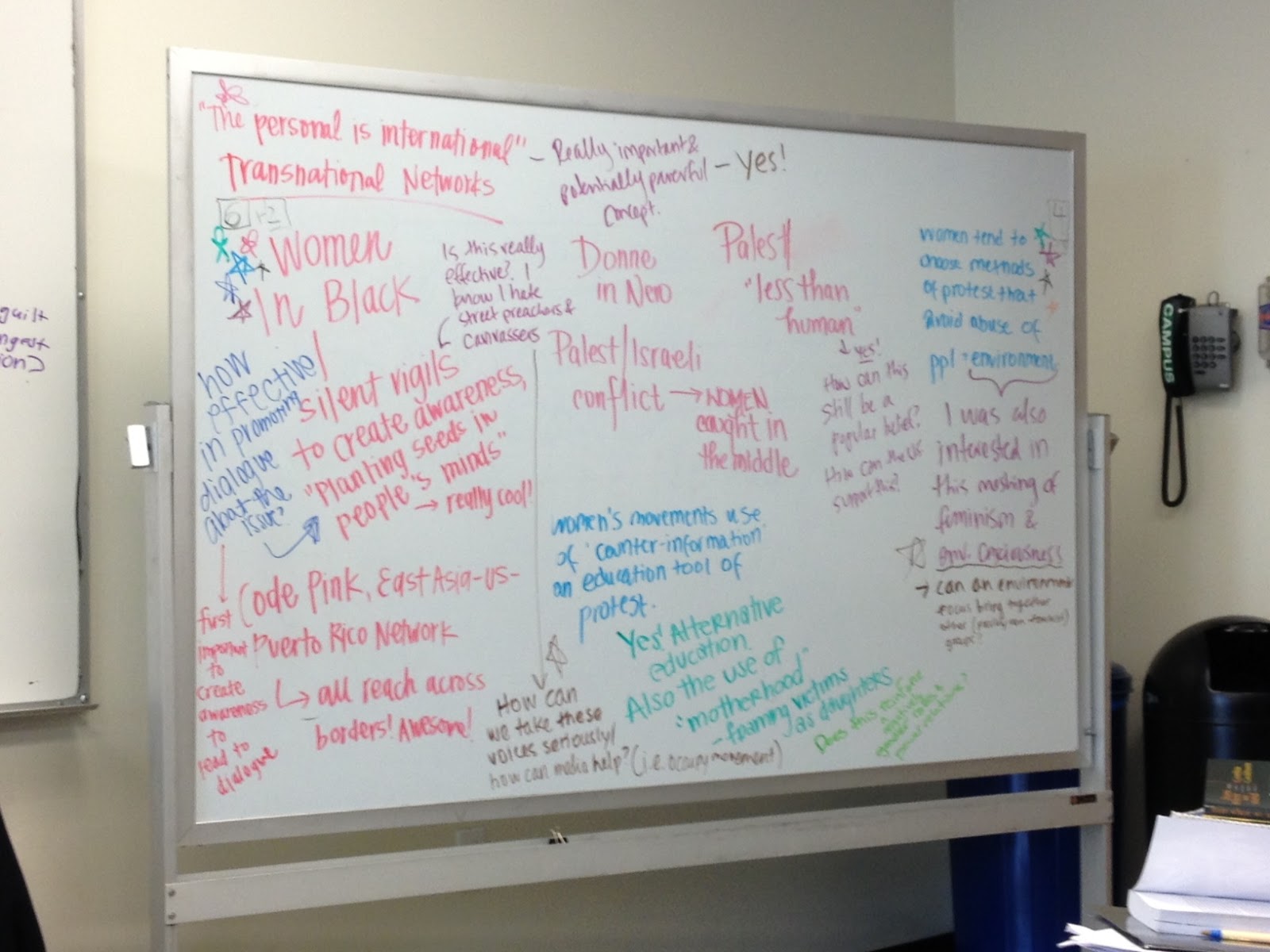
Silent Discussion : 03/04/2013
Click on the image to see the original photo size, which allows you to zoom to see the text.


Subscribe to:
Posts (Atom)